Air Force Training, SIR!

The last time I was in San Antonio was almost 23 years ago when I was in the midst of Advanced Flight Training held at Randolph Air Force Base, and, at the end of which, I earned my Wings of Gold. As we were fond of saying then, it was six weeks of Navy training crammed into six months of Army Air Force training, SIR!, which left plenty of time to explore the area.  All the military services have good-natured (mostly) rivalry that often points to the subtle differences among them and this cartoon I found online pretty much sums it up.

military_jokes_by_the_demon_king999

To distinguish how the Navy and the Air Force operate differently, our class was briefed by one of our Navy instructors on day one at Randolph.  He said something to the effect of “The Air Force tends to provide you a well-indexed, voluminous tome that in great detail defines what you can and cannot do whereas the Navy will toss you a pamphlet listing in bullet format what’s really unacceptable and then gives you the freedom to sort how to best accomplish the task at hand.”  My brief time in Air Force Training Land demonstrated the veracity of that assessment time and time again, which often translated to considerably less pressure while learning the art of long-range navigation by air.  Almost unimaginably, this skill set included learning how to take sextant shots, both day and night, from a moving aircraft to practice celestial navigation, which, sadly, has become a lost art.  After the intensity of Navy Primary Flight School in Pensacola, my whole class of fellow Navy Ensigns was thrilled to throttle back a little and luxuriate in the Air Force way.

With relatively more down time, many of our class stepped out a few times together to check out the Alamo and eat along The Riverwalk, because that’s what you do in San Antonio. Impish at heart, I rather enjoyed rattling some of my classmates, especially those who espoused local history (some almost religiously), by feigning my ignorance of key events that transpired south of the Mason-Dixon Line, “The Alamo?  Wait, wasn’t there, like, a big fight there?  And I think John Wayne was there…”   In response, one of my classmates from the heart of Georgia observed, “Aw, (TACCO), you’re all ate up with the Yank, aintcha?”  Not sure what to make of that, I said, “Um, thank you?” He imperceptibly shook his head, paused before answering and gently said, “Uh.  Naw,” letting me know that his assessment of me had dropped yet another notch by failing to comprehend the depth of the southern insult.

Frankly, more than twenty some odd years later, I’m still not quite sure what that turn of phrase means, but I’m fairly certain it’s not good.

I was adopted by my first dog (a German Shepherd puppy named Lancelot) half way through my training at Randolph, which meant I “stayed in” for most of my later months as most of my free time was consumed by logging countless hours walking Lancelot to ensure I had relatively uninterrupted sleep or chasing him down as he tried to eat my navigation charts.  Lancelot had this weird thing for paper – and eating rocks. But I digress…

While my time in San Antonio wasn’t particularly memorable, aside from getting winged and collecting fodder for future dog shaming posts, I thought it important to share at least The Alamo and The Riverwalk with our kids.  Flight, having been wholly underwhelmed by his few visits to San Antonio during his stint in Corpus Christi for his own Advanced Flight Training, assured me he was just fine missing that particular pilgrimage so we planned for it while he was on a trip.

After a solid Wednesday morning of homeschooling, the kids and I loaded into the car and drove the 90 minutes to San Antonio.  Before we got on our way, I learned that, as the nickname would suggest, the “Mission City” boasts an extensive mission network that has been turned over to the care of the National Park Service.  While I had known what had led to the rallying cry of “Remember the Alamo!” I hadn’t realized that what remains today of the Alamo was originally built as a Spanish stronghold, a presidio, to support further colonization.

When our nation was still just a collection of European colonies, each trying to outpace the others in expansion efforts, the Spanish crown was interested in growing their empire in both population and property and came up with an ingenious plan. Recognizing that these symbiotic efforts were best accomplished together, they first acquired new citizens who would then lay claim to (and pay taxes on!) land that broadened Spain’s boundaries. In order to become a Spanish citizen, there were three main hoops through which the native population had to jump: 1) learn enough Spanish and Latin to effectively communicate and observe Mass; 2) convert to Catholicism, a requisite for Spanish citizenship; and 3) learn a trade to contribute to society at the lowest level of the Spanish caste system.  Before these potential citizens could be so transformed, it was necessary to establish a local military stronghold to protect the crown’s investments.  In 1718, what is now The Alamo was the initial presidio from which the massive conversion campaign was launched through now central Texas, and four other mission sites branched out along the San Antonio River.
IMG_0907.jpg

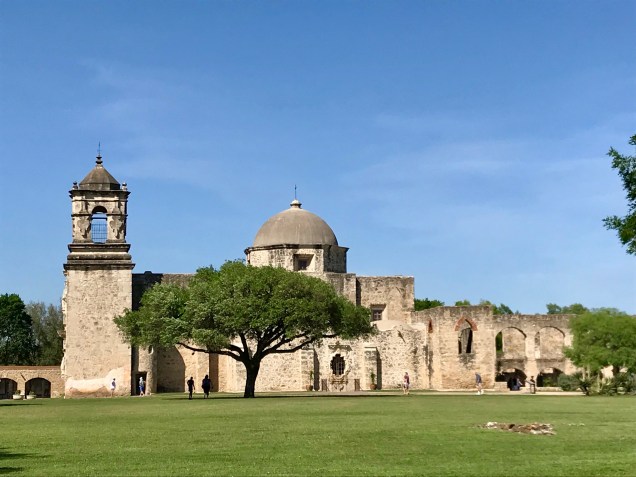
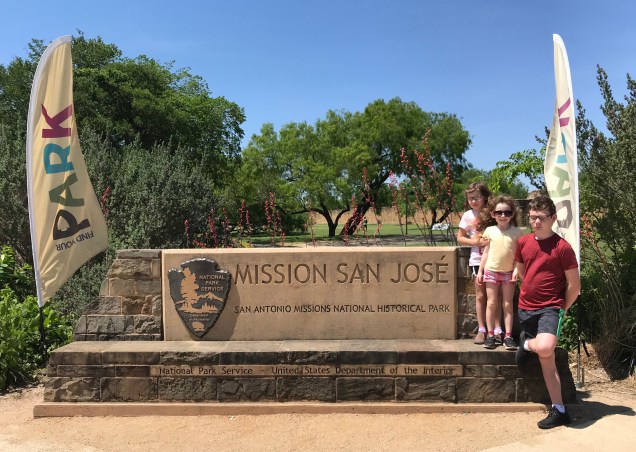
We spent most of our time at the San José Mission, which is where the National Park Service has their Visitor Center.
IMG_0857 (3).jpg

After picking up Junior Ranger books for the girls there, we emerged from the introductory film just in time to join a Ranger-led tour, which was especially noteworthy.  We were led about the compound on an hour-long journey where we were introduced to the initial various inhabitants of the mission and their respective roles therein.

The tour was very well done and I especially appreciated hearing both the European and the native population’s sides on how it all went down in the early 1700s.  The native hunting and gathering tribes throughout what is now Southern Texas and Northeastern Mexico were collectively known as the Coahuiltecans.  These nomadic people had struggled with warring tribes to the north and fell prey to European diseases to which they had no immunity.  The provisions and protection offered by the missions (minus the diseases) and this new way of life may have appeared the lesser of two evils.

The native people were welcomed into these compounds and offered two solid rooms for each extended family, who then took a weekly delivery of beef and corn rations and had access to several shared wells and outdoor ovens, all in exchange for making progress on becoming Spanish subjects.

On the other side of the compound lived the next higher up on the social ladder, Spanish merchants hailing from all over the world.  In addition to learning foreign languages and adopting new religious beliefs, the converts were educated on the arts of agriculture and other crafts practiced in the far-reaching corners of the Spanish Empire. Once these skills were mastered and the new citizens baptized, they were turned outside the protection of the mission walls to fend for themselves in this new way of life (and to free up new rooms for the next family).  It was quite an assembly line the Spanish crown developed to further the Empire.

It goes without saying that the focal point for any mission compound is the church, and this one was simple, but lovely on the inside.

IMG_0865.jpg

I was captivated by the two-story gallery running the length of the building and was surprised to learn that only three religious leaders were in residence here: a priest and two laypeople.

IMG_0872.jpg

Just beyond the arch on the far right is a personal garden and well.  Apparently there was sharing of neither wells nor veggies with the commoners. !!!  I guess it was good to be at the top of the social ladder.

After our tour, the girls brought their completed Junior Ranger books into the Visitor Center to receive another badge.

IMG_1728

More so than the other two, Firebolt was stoked about the Ranger-let tour and she gushed, “I really liked the tour – the Ranger made it all come alive, it was like I was watching a movie in my head.” And then she tentatively added on, “I think maybe I want to be a Ranger.”  High praise indeed.
IMG_0901.jpg

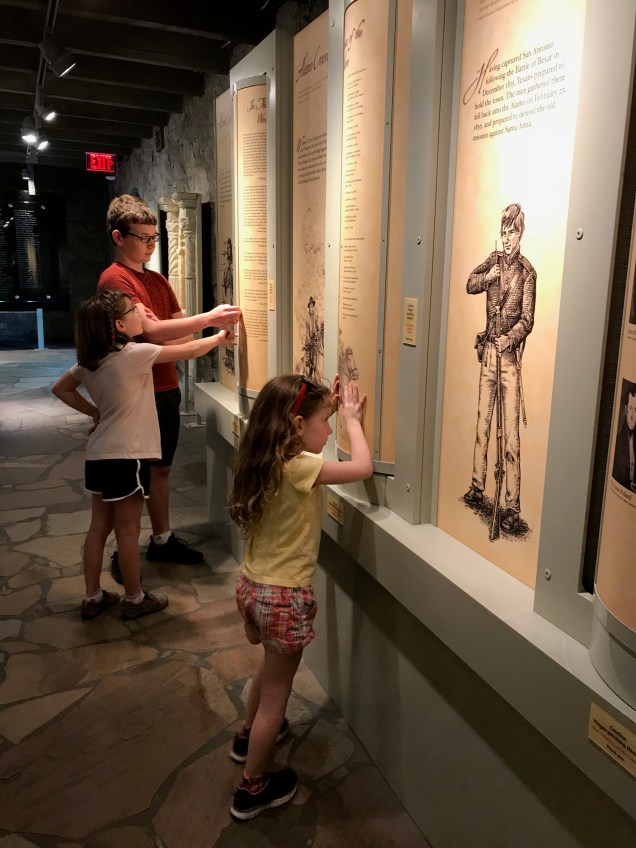
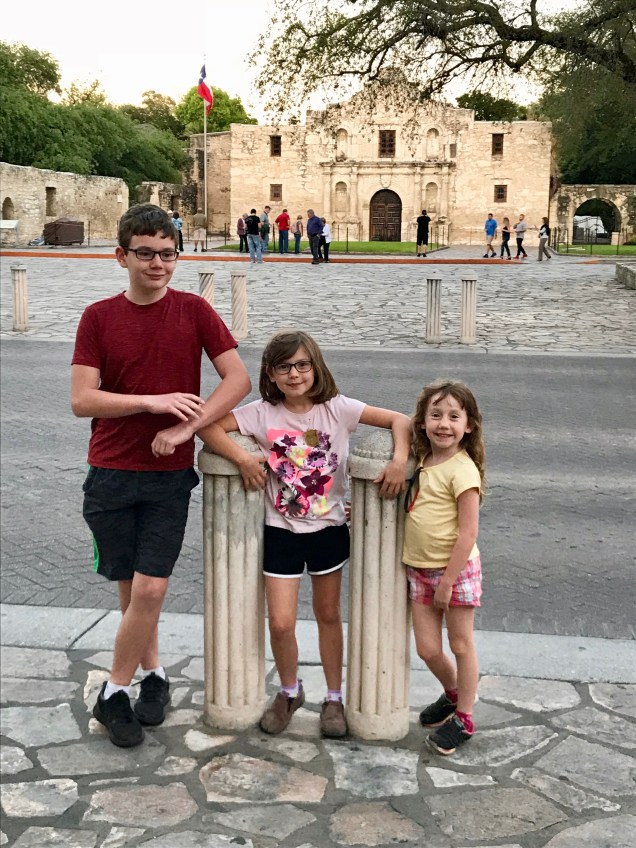
From the San José Mission we headed into downtown proper to see The Alamo.  By then the kids were just about historied-out, so it was okay that we arrived only half an hour before The Alamo closed.  We saw the main museum exhibit, moving through it with a purpose lest we get locked in.  IMG_0923More interesting than the folks involved in or the details surrounding the legendary standoff, our kids couldn’t get enough of the enormous koi, making wishes in the fountain, or trying on coonskin hats.
IMG_0939

IMG_0934

Apparently equally underwhelmed by The Alamo, maybe our kids, too, are all ate up with the Yank?  At least they come by it honestly…
IMG_0977.jpg

The closing of the Alamo signaled the start of a search for a dinner venue, hopefully located somewhere along the Riverwalk, and we popped into several interesting stores along the way.  Check out the Nacho Libre fans below.

After stopping in a store that must be a cousin to IT’SUGAR where we found scrumptious birthday treats for our cousins, we identified the perfect San Antonio place to eat.

IMG_1732

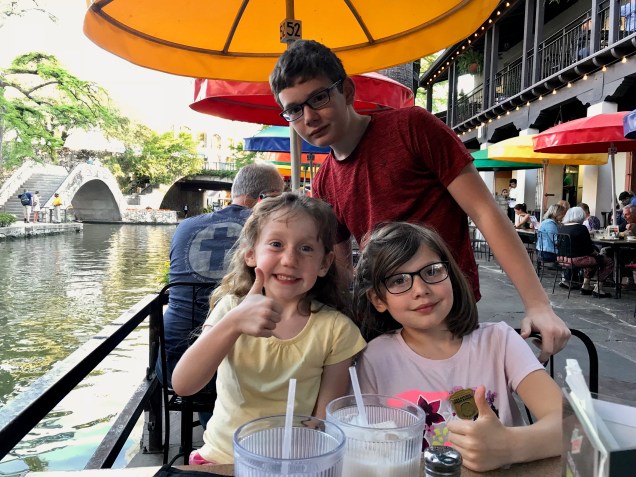
I thought Casa Rio was nothing to write home about, but the kids were thrilled with their dinner choices and gleefully observed, “Mom, they have HORCHATA!” before each ordered some of their favorite beverage.
IMG_0957.jpg

We dined leisurely, watching tour boats cruise by, all aboard delighted by the unfailing smiles and enthusiastic waves from our girls, and then we meandered along the river to see what we could see.

In the waning sunlight, we retraced our steps to the Subaru.  Our drive back to Austin was uneventful and the perfect ending to seeing the best of San Antonio in six hours or less, making for a healthy amble down memory lane.  Not bad for a gaggle of Yanks…

There Will Be Brisket

But not quite yet.  First we had to drive through oil country.

Oh, and I drink your milkshake!!

That was random and pointless – I just wanted to work it in somewhere in Texas.

I’m surprised at the extent to which I was, until really just a few days ago, ignorant about oil country.  Technically I grew up in it, though Southern California’s version of it is fairly unobtrusive… oil drilling platforms visible off shore from just about any beach, and these vaguely horse-like guys Derrickbobbing up and down and dotting the landscape.  I grew up calling them “derricks” but wasn’t sure that was right (it is); I only today learned that they’re also known as “sucker rod pumps.”  You’d think as a kid we’d have preferred that more, um, colorful name, but I guess that’s a downside to not having had Wikipedia to reference back then – we never knew.

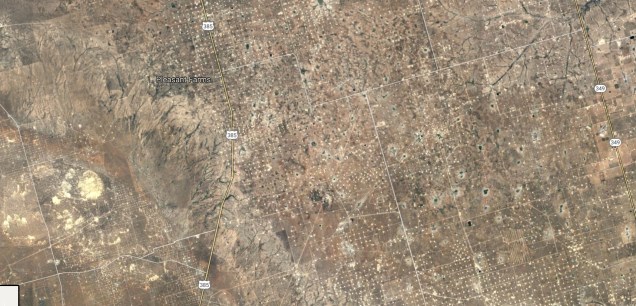
My assumption regarding Texas oil country had always been that it consisted almost entirely of the vast network of offshore platforms scattered in the Gulf of Mexico off the coast of Galveston and east toward the mouth of the Mississippi.  Bad assumption; it’s much more than that.  There is an enormous swath of West Texas and a bit of New Mexico that is absolutely covered with oil wells, and not much else.  Tens of thousands of square miles of this.  I had seen it from the air, too, and wondered what all the little dirt roads leading to tiny circular clearings were.  It looks like this:

Oil aerialOil aerial 2

But back to our drive.

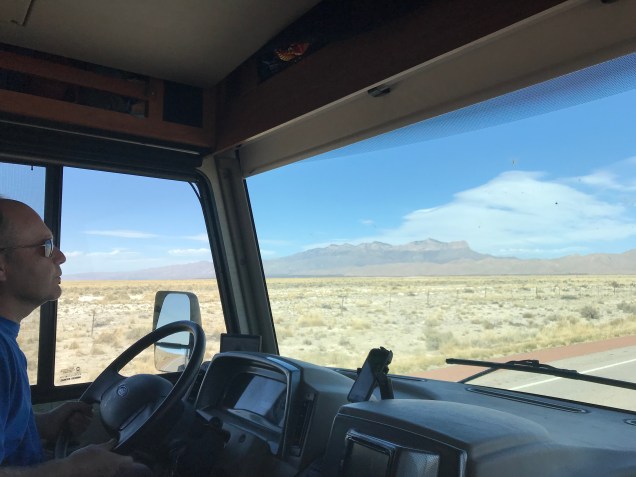
We did another dawn patrol (pre-dawn really) out of Guadalupe Mountains and were on the road by probably about 4:30AM.  I had wanted to reach Texas Hill Country by early afternoon, and we lost an hour almost immediately to time zone traversal, so I was patting my own back in between sips of coffee as we rolled down the road through the middle of nowhere.  My expectation had been that we would barrel down the empty two-lane roads and be halfway to Austin before anyone stirred.

It was not that way at all.  It started quietly enough, with the occasional oil well passing by in the distance.  But as we approached one of the first intersections, which on paper looked tiny, I could see a line of traffic going both directions as far as the eye could see.  This was the road on which we needed to turn; I had not expected traffic at 5AM in a blank spot on the map.  Here’s where we were:

Oil Country

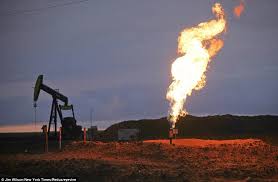
Closer inspection revealed that not only was this extremely heavy traffic, but it consisted almost entirely of trucks, from F-150s to semis. And when I say “almost entirely,” I mean that I think we were the only non-truck on the road.  As I made a right onto the road (fortunately via a 4 way stop from a road that didn’t have any traffic, or we’d have been sitting at that intersection for an hour at least!), I found myself in a post-apocalyptic Mad Max scene of blinding headlights, big rigs, noise, and blowing dust, accentuated by oil wells all around.  And not just oil wells, but the kind that have flames shooting out of the top, which cast a fluctuating orange glow through the dust.

flame

“Surreal” doesn’t do the scene justice.  In between squinting at the blinding lights and attempting to keep Davista in her lane on the narrow, busy road (there was a good bit of wind, too), I marveled at what I was seeing.  Where are all these people going?  Why so early?  There are no towns nearby – where do they live?  Is this a normal job, or is this “hardship duty” that you do for a year or so to earn some good money and then go back to your normal oil job?  How often are there accidents out here?  If there were one, would anyone be able to get to you?  Do people know about this place?

It was a crazy and singular experience.  I had departed expecting a quiet, contemplative, pre-dawn glide though the desert and found myself in the middle of our economy’s vigorously beating heart.  At 5 AM!  And then the sun rose, we reached Fort Stockton and I-10, and suddenly it was another normal morning on the road.


Going Underground

Flight gave a great description of our departure from Phoenix under the cover of darkness.  After I rejoined the land of the living, I took the opportunity to do some writing and gather my thoughts on our way out to Guadalupe Mountains National Park.  For a large stretch of our drive, there wasn’t much scenery to keep my attention (save the cute boy I married) and I escaped into the memories of Phase One of our travels.

IMG_0554 (1).jpg

We arrived at this National Park in the nick of time and pulled into the second to last first-come, first-served parking slips for us to stay for two nights.  Two other RVs pulled in shortly after we.  Although initially this campground served as a base from which we could explore Carlsbad Caverns, I’m glad we took the opportunity to learn about this particular corner of the country while the girls completed another Junior Ranger Badge program.

IMG_0567.jpg

A little snapshot of what I learned…  Some eleventy billion years ago, this stretch of the desert was actually in the middle of a shallow three-basin sea.  The Delaware Basin served to form Capitan Reef at its edge, the remnants of which formed the foundation of the Guadalupe Mountains.  Although you’d never know it, apparently this park is riddled with sea creature fossils and shares its creation with its neighboring National Park, Carlsbad Caverns.  Unfortunately, we did not budget any hiking time into our brief stay, but some of the trails look to be pretty spectacular.  Next time.

As soon as the GMNP Visitor Center was open the following morning, we popped over so the girls could finish the requisite booklets to earn their badges.

Their favorite activity was a scavenger hunt through the exhibits.  In addition to the expected specimens of fox, skunk, skink, and desert rat, there was also a tarantula hawk on display.  The name might call to mind a shrewd bird of prey, but you’d be wrong.

Tarantula hawk

The tarantula hawk is instead a giant wasp that hunts these sizable arachnids, delivering a sting to paralyze them, after which they lay their eggs inside the immobilized spider who is then devoured alive from the inside out by the growing larvae.  Gross is the first word that comes to mind, yet falls so short of the gruesome reality.  Now, I am no fan of arachnids, especially big hairy ones, but even this seems over the top on the fiendish scale.  The tarantula hawk is especially nasty to its prey, but, should a human be stung by one, the peer-reviewed scientific advice is to lie down and start screaming.

I’m not making this up.

(And I am very thankful that I waited to further my knowledge of this species until I was very far from its natural habitat.)

Carlsbad Caverns boasted no such ghastly beasties.  Only bats. Lots of them.  Somewhere around 400,000 colony residents, in fact, comprised of 17 different species.  These numbers can surge to nearly double that during spring and fall migration seasons.  We did learn quite a bit about White Nose Syndrome, the fungus that is decimating the global bat population that has been referenced as part of the Sixth Extinction.  !!!  We saw neither hide nor free-tail of the legendary colony, likely because 1) during the day most of the colony sleeps in a cavern closed off to the public and b) we didn’t stay to see the daily mass exodus at dusk.  This picture from the National Park Service website makes that evolution look pretty cool.

bat_outflight_hristov_556.jpg

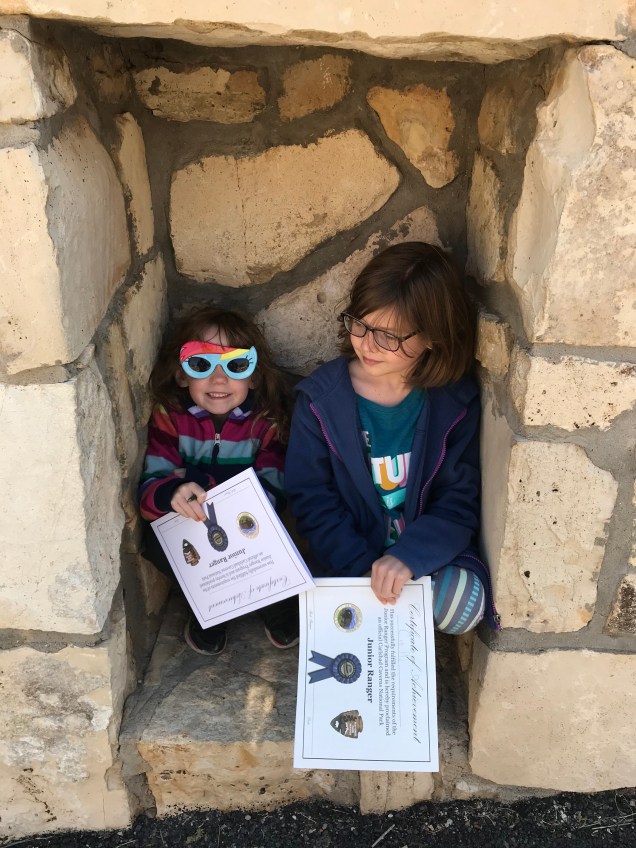
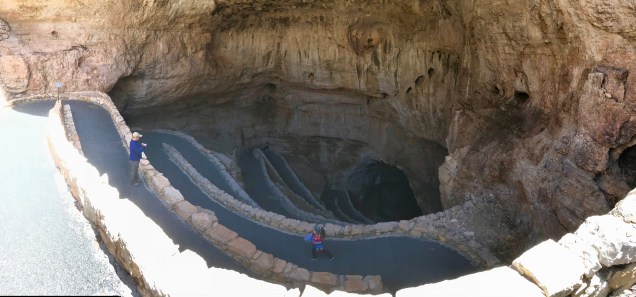
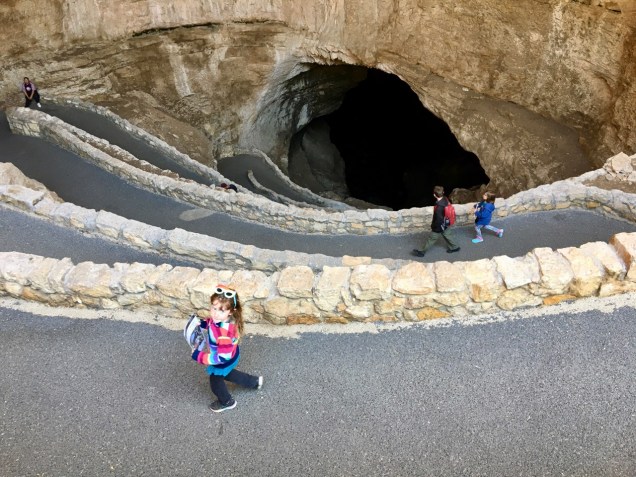
We arrived at the topside Visitor Center in the early afternoon and, at the recommendation of the Rangers at the front desk, ate lunch before we started the hike. Although there is a little café down below at the far end of The Big Room, we were informed that there would be slim pickings as the elevators down were out of service and, as the full assortment of nourishment could not be humped down the winding cavern switchbacks, they were offering little more than bottled water and Clif bars.  After filling our bellies, we made our way to the underworld entrance, pausing for a photo of the girls somewhere only they could get into, before we began our descent.

IMG_0575.jpg


IMG_0581.jpg

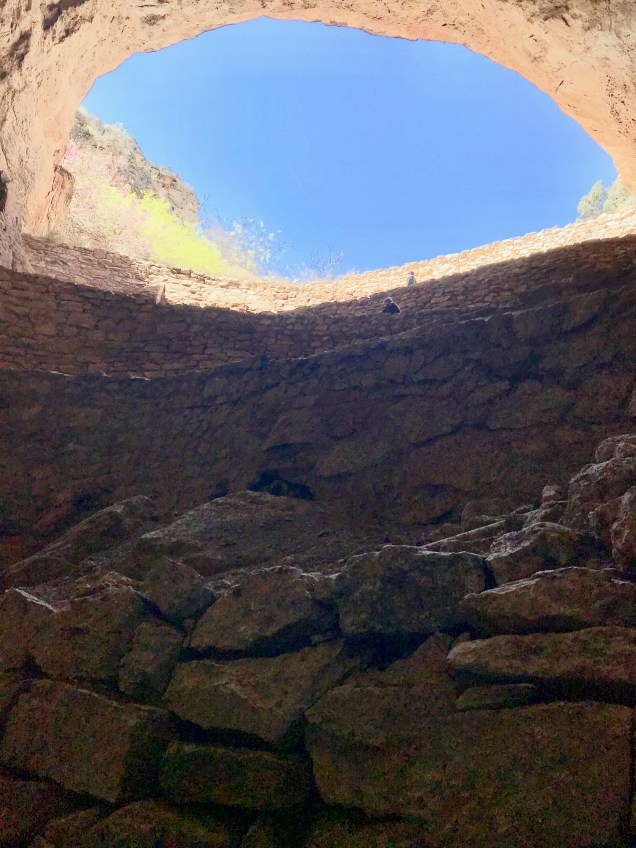
And here’s a view looking back up.

IMG_0582.jpg

The going down was fairly easy despite the hairpin switchbacks.  I thought the return to the surface would be a little trickier, but hopefully not quite so laborious as the general population of earlier visitors made it seem.  Although some of them appeared to be on the other end of the fitness spectrum from American Ninja hopefuls, I realized that, despite our descent, we did start out about 4400′ above sea level. !!!  Because I was not yet focused on puffing my way back up, my thoughts were allowed to wander and I recalled the last time I had so gone underground.  I took the kids down to Luray Caverns in Virginia on the day of the last Presidential Election, and wondered again how symbolic the timing was of that excursion to the earth’s bowls.

As we descended lower, my ambling train of thought was rerouted to take in the immediate sites.  Pictured below are a collection of “soda straws,” hollow stalactites that break really easily when you try to pull them from the ceiling.

IMG_0584.jpg

Kidding!  I have no first-hand knowledge of this (and our Junior Rangers would have reported me if I did), but that sure looked to be the case. Our next pause in the descent was at the Whale’s Mouth, made up of smooth drapery formations.

IMG_0591 (1).jpg

And this stalagmite is just plain ugly.

IMG_0592.jpg

No idea why it has been showcased by illumination, but there you have it.

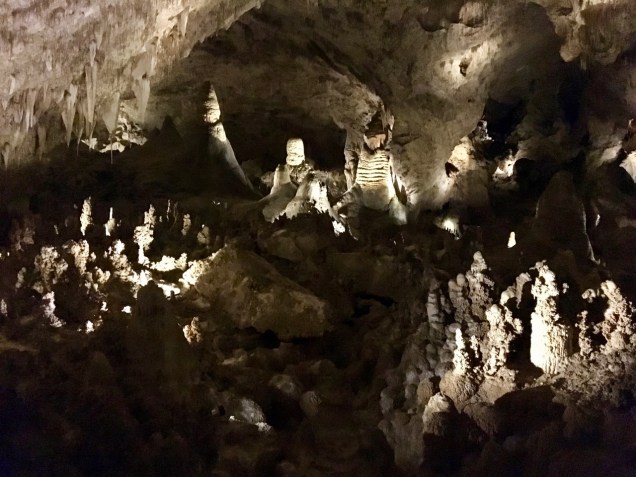
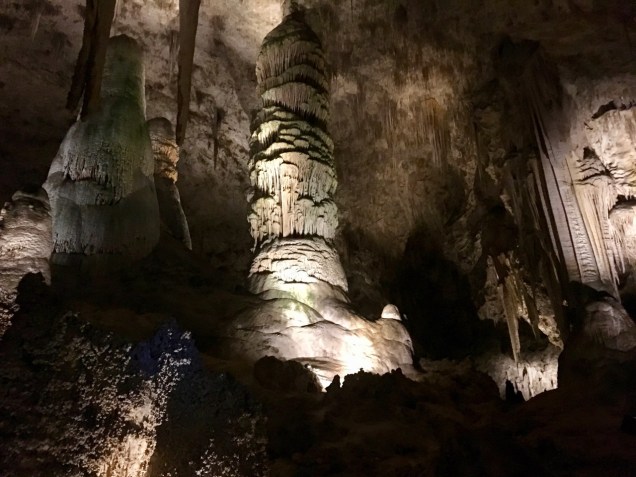
We next found ourselves in the Hall of Giants where three massive speleothems grew from separate stalactites and stalagmites into columns eons ago.

IMG_0606 (1).jpg

If you patiently wait a few millennia, you might see a few other such columns form.

What struck me most during our visit to the netherworld was the fact that everything we were seeing had been made (only a few formations remained active) in the absence of any light at all.  During our hike more than a million light bulbs were illuminating our path around the Big Room, drawing attention to the below formations, and it was a little trippy to consider that with the flick of a switch (and the failure of numerous generators), the caverns would again be in total darkness.  Everything we’d seen on our way to, from, and in the Big Room would then sit here entirely unobserved, as it had for innumerable years, slowly growing under no one’s watchful eyes.

When we stopped briefly to get some water at the subterranean café, I told Flight that you couldn’t pay me a million, trillion dollars to work there, especially if it meant I had to take the elevator up and down every day to get there.  A little aside, a friend recently told me that only the week prior to our visit, one of the two elevators still in service came to a halt mid-transit, stranding three people inside due to a mechanical failure.  Fortunately, all three were safely recovered and lifted by harness to safety.  To that I say, “Nopety, nope, nope, nope.”  If necessary, I’d hike in and out every dang time.

I recognized that it was time to climb back out of this enormous hole in the ground when I started imagining what would happen if the aforementioned magical switch were indeed flicked to OFF and/or backup generators failed, and suddenly there were no lights at all, for I knew I would have died a frightfully slow and slowly frightful death trying desperately to feel my way out of the cavern.

While regrouping over water, Flight briefed the kids on the basic rule of our ascent:  the kid who complains the least on the hike back up wins.  Detail-oriented WoodSprite asked, “Wins what?”  “Bragging rights,” was Flight’s response and we trudged our way upwards, weighing whether borderline innocuous comments such as “Wow, are my legs tired…” constituted a whiny point against the speaker or if it was simply stated as a point of information.

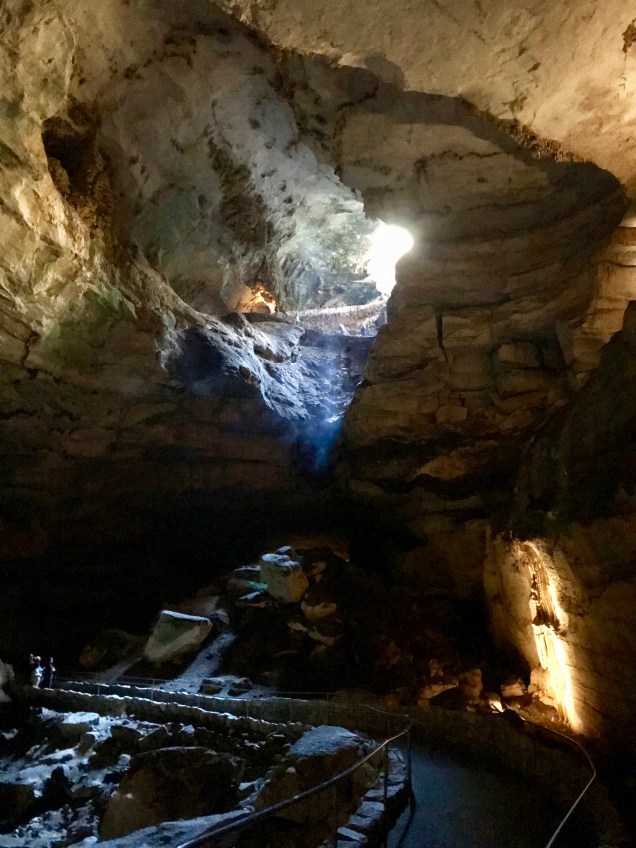
At last the lighting seemed even more otherworldly to me and I belatedly realized it was because we had made it to the “twilight zone,” where the natural light coming in from the entrance casts an eerie pall for a short distance (see below), beyond which it would become pitch black without mankind’s intervention.

IMG_0586

Most creatures have far greater sense than to wander in beyond the twilight zone (not so we) and I joyfully celebrated our return to broad daylight.

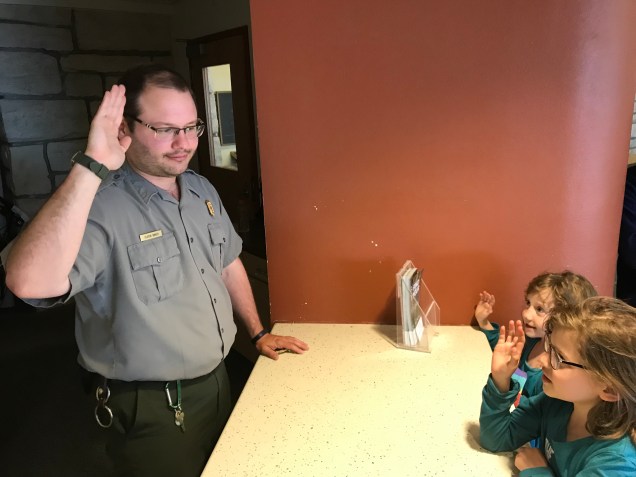
One last stop in the Visitor Center to swear in our Junior Rangers.

IMG_0658

And so that I might learn about my newest least favorite profession (I’m collecting them along this journey), Bat Guano Mining.  Considering the Caverns were discovered in 1898, local entrepreneurs wasted no time in capitalizing on the caves’ seemingly endless supply of bat guano, and mined the pungently rich fertilizer by lantern light from 1902 to 1958.  Um, no.  No, thank you.  The underworld gift shop/café position suddenly seemed far more desirable.

IMG_0659Overall, our time walking on the bottom of the former Delaware Basin (and well below!) was rich with sights we’d never before seen, learning about occupations I have zero interest in pursuing, and studying up on creatures I have no desire to meet.  Our brief exploration was absolutely time well spent, yet I find myself eager to move on to the Hill Country, putting a healthy distance between potential underground grid failures, tarantula hawks, and me.
Twice the Parks, Half the Scenery

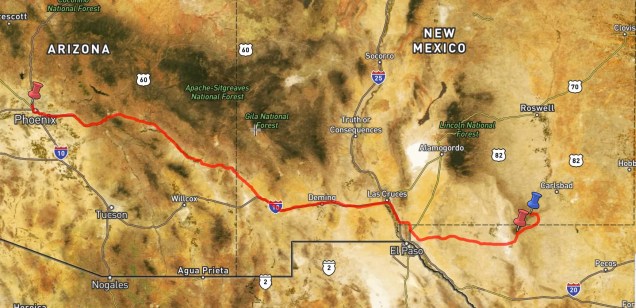
Departing Phoenix we tried a new version of the dawn patrol, which worked quite well.  Essentially we front-loaded all the work the night before so that Go Time mostly just consisted of waking to my alarm, making a cup of coffee (and taking a quick shower) to get me coherent, and rolling into the pre-dawn.  We had covered quite a bit of ground before things reached their normal activity level in Davista.

PHX to CC

While eastern Arizona was quite beautiful, particularly the parts that traversed the mountains, southern New Mexico was less so.  I kept searching for something to find interesting, but didn’t have much success until Las Cruces, where the Rio Grande valley greens things up a bit and a sharp ridge of mountains behind it teases at some more intriguing surroundings.  But alas, the Rio Grande was where we turned south toward El Paso, so we never quite reached those mountains.

I’ve been to northern New Mexico in the higher elevations and loved it, so this stretch of road did nothing to dampen my enthusiasm for our planned return to the state’s mountains later this Spring.

Bypassing El Paso to the north, we joined a two-lane road that led us through barren desert toward Guadalupe Mountains National Park, still in Texas but just, and our jump-off point to Carlsbad Caverns.  I had initially reserved another campsite in New Mexico from which to drive to and explore the caverns, but the more I looked at it, the higher the sketchiness factor appeared.  Comments from the “reviews” section of a website I use to scout campgrounds contained phrases like “not too much trash” and “just far enough from the road so they can’t see you” as well as the somewhat more ominous “felt a little off…”  Nahhhhh.  Out here I would’ve been happy to do a Wal-Mart parking lot, but there were neither Wal-Marts nor parking lots, so expanding our search into TX and finding a national park I’d previously never heard of with a campground that took RVs was a no-brainer, even if it was first-come-first-served.

IMG_0879

I just mentioned that I had never heard of Guadalupe Mountains National Park, right?  Yeah, it’s tiny.  Basically a nubbin of a short mountain range in southern New Mexico (the same one in which Carlsbad Caverns is found) pokes into Texas at its southern end, and in doing so creates the highest point in the state at 8,749’.  There’s a small visitors’ center and a campground, which was really just a three-row parking lot with a bathroom, at least the RV side of it.  The tent side looked a little more scenic, but was equally diminutive.  The sole trailhead sat 20 feet from our parking spot campsite, and from there it appeared that you could do some solid hiking.  I will give it that.  Yet… Tacco and I found ourselves speculating on what sort of horse trading might have been involved in the establishment of this place as a national park.  Maybe we’d have felt differently had we done some of the hikes, or if we were from Texas and felt like we deserved to have at least a couple national parks since Utah and California get to have so many.  Kidding!  Mostly…

Regardless of its relative modesty, it was reasonably pleasant and safe, the girls knocked out another Junior Ranger program, and Keeper, who has of late developed an interest in cooking shows, fixed us an outstanding dinner.  A friend of mine once told me she loved guys from Louisiana because “they call you ‘darling’ and they’re all great cooks.”  Keeper will almost certainly never be from Louisiana, and doesn’t have the chops yet to call anyone “darling” (which will probably suit him well even when he does have the chops), but he’s way ahead of the curve on the cooking part!

IMG_0880

IMG_0881

The next day was our Carlsbad Caverns day, and was something I had been quietly looking forward to.  The idea of a no kidding cavern with crazy limestone formations and underground pools and stalactites and stalagmites all up in your face is something I have always been fascinated by, yet so far I have managed never to see one in person.

The caverns have a natural opening of course, out of which tens of thousands of bats swarm each dusk on their search for insect meals.  We weren’t there at the right time to see them unfortunately, but learning this factoid answered my “how did they find this cavern in the middle of nowhere?” question.

Most visitors, however, descend into the 800’ deep caverns via elevator from the visitors’ center, which seemed like a cop out to me.  I was actually pleased to discover that the elevators were out of service during our visit, taking this option off the table.

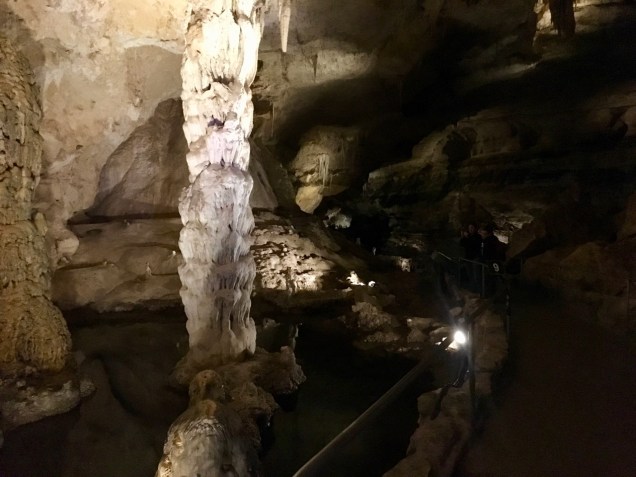
IMG_0892Beginning a hike with a steep descent, negotiated via switchbacks, was a first for me as well (clearly I’ve never hiked the Grand Canyon either).  I was surprised, though I shouldn’t have been, at how quickly the light was gone and replaced by the extensive artificial lighting network the park service had installed.  It was only a hundred or two feet down where we read that at this depth, without the artificial light there’s nothing for your eyes to even adjust to.  Just pure black.
IMG_0894

Noteworthy also was the condition of what appeared to be a vast majority of the visitors climbing back out of the cavern.  Bulging eyes, stopping every hundred feet or so to gasp for breath, pale and sweat-covered… I have to admit it made me wonder whether 800 feet was a much greater vertical distance than I was remembering it to be, or whether cave air robs you of your oxygen or maybe just your mojo in some mysterious way.  Not that any of these people appeared to be endurance athletes, in fact far from it in most cases, but their apparent exhaustion certainly seemed excessive.  Was this a more taxing hike than it appeared?  Would I be carrying out the kids on my back?  I filed these thoughts away for later.

The sheer size and labyrinthine nature of the complex of caverns overwhelmed me as we continued to descend.  I absolutely can not imagine exploring something like this armed with only a headlamp and a rope.  Yes, I understand that they have a system for ensuring they don’t get lost, but that would not be remotely enough for me.  It’s easy to forget, when you’re wandering around gawking at everything, that this place is now lit up by thousands of lights (and it’s still only very dimly lit) and that you’re walking on paved trails with handrails.  Safety rope or not, it would be terribly disorienting, and with a constant nagging fear (for me at least) of some sort of malfunction causing me to be enveloped by darkness and hopelessly lost.  Evidently I am not a closet spelunker.

IMG_0895

All that said, the caverns were stunning.

IMG_0917

IMG_0910

IMG_0919

IMG_0904

We traversed the entire loop trail and stopped near the “rock of ages” to complete Junior Ranger activities.

IMG_0913

Prior to our own ascent I recalled the sight of the sweaty zombies emerging during our descent and decided to attempt to get ahead of the kids’ inevitable complaints about the climb.  My exhortations about their hiking skills and the fact that they had easily conquered several more difficult hikes may have had some effect, but I think it was my turning it into a “who can complain the least” game that truly pushed them over the edge.  Gamification wins!  They killed it.  As it turned out, 800 vertical feet is just about what I remembered 800 vertical feet to be, and wasn’t particularly tricky.  Keeper and Firebolt blazed the trail and reached the top a solid five minutes before the rest of us, with Keeper declaring that he felt like returning to the bottom and coming back up again, just because.  Even Woodsprite managed not to complain, and we hardly broke a sweat.  I was proud of my family.  I did, however, find myself musing, at about the 2/3-to-the-top point, on the general physical condition of the average American.

After a bit of messing around back in the visitor’s center, IMG_0921we made our way back to Davista at Guadalupe Mountains NP and set up for another dawn patrol after an early night.  It would be another long drive through Texas to Austin in the morning, and despite our short stay in the area, we felt confident we had seen everything we ought to have.  My post title was a touch snarky, but in truth I’m glad we made this visit and got to dip our toes into this region of the country.  It’s entirely unique and fits well into the whole, even if it contains very little that screams “look at me!!”  It helped us all, I think, to understand a bit better how vast the landscape is once you get outside the cities.

Musical Instrument Museum of Phoenix

In addition to spending time with Flight’s college roommate and his family, we had the opportunity to reconnect with some of my own extended family and some dear friends from our time in Whidbey Island.  Back in the day, before Flight and I were even dating, I had the good fortune to find the Skagit Scottish Country Dancers.  Let’s go a little further back down amnesia lane to put this all in context… 

When I was six years old, my Mom took me to a Burns Night Celebration or something of the like and I was mesmerized by the Highland Dancers.  No kidding, my Mom saw the look on my face and asked me, “Would you like to do that?”  With a slow-motion nod, I turned back to face the stage. I was utterly captivated by the briskly moving kilts and the complex footwork, all in time to droning pipes – what’s not to love?  Just don’t ask my classically trained violist Dutch father…

No, it’s not Riverdance, which has its roots in Ireland.  Highland Dancing is so named because it comes from the Scottish Highlands, where, traditionally, it was only done by men and served as a way for warriors to warm up before battle.   Each of the dances has a story behind it, which touches somewhere deep in my Celtic soul.  For example, the Highland Fling is a victory dance that was to be performed on the shield of your defeated opponent, which means you had to stay in one spot, which, although certainly challenging for a six-year old novice, proved easier as I trained.  To give you some sense of what this extremely athletic sport entails, here are a few images I found online:

Now the competition fields are dominated by women.  If you are curious, you can see the 2017 World Champions performing their Highland Fling victory dances here.

Where Highland Dancing was traditionally done by male warriors, Scottish Country Dancing is the Scots version of ballroom dancing, which if you’ve ever been to a Ceilidh (unbelievably pronounced kay-lee, and is Gaelic for “gathering”) is probably more appropriately done in a pub than a ball room.  Scottish Country Dancing is featured in one of my favorite movies from 1945, “I Know Where I’m Going,” where the Highland Schottische (pronounced “shotteesh”) is done moving about a ballroom.  A more recent (1994 is more recent, right?) cinematic debut of Scottish Country Dancing was in “Shallow Grave” with Ewan McGregor dancing Strip the Willow alongside his still living flatmates.  

Highland Dancing and Scottish Country Dancing are very differently performed, and it took me a while to get my ghillies (dance shoes) to comply with the new demands.  However, in my first dance class I felt immediately at home when a seasoned fellow took one look at whatever Beat Army t-shirt I was wearing, walked right up to me and asked, “Did you ever Beat Army?”  

Feeling a little sassy to be so challenged, I retorted, “Yeah, did you?”  

“Yeah. What’d you Beat Army in?”
“Swimming and Diving. How about you?”

“Football.  What company were you in?”

Following an exchange of our Academy pedigree, this fellow then asked me, “When did you graduate?”

“1994.” It was 1998.

An eyebrow raise, “Wow.”
“Why? When’d you graduate?”

“1959.”

I have never had a solid poker face and, astonished that he was still so nimble for someone so advanced in his years, I offered a two second, “Wooooooooooooooow!” to go with the astonishment that was clearly written on my visage.

“Well, you don’t have to say it like that…” and we were fast friends thereafter.

This fellow Academy grad and his lovely wife have been in Anacortes forever.  He was a P-2 pilot back in his day and went on to fly with Northwest Airlines before retiring and taking up steam-engine building full-time.  I’m not sure where playing the fiddle came into being, but he is also quite a musician.  His wife also danced and rescued wildlife critters in her spare time – what a fun couple!  These were just two of the lovely folks I got to meet among the Skagit Scottish Country Dancers, our teacher was fantastic.

Despite having grown up in Scotland (or maybe because she had grown up there?), our teacher and her English husband had fallen in love with the Whidbey Island years before while he was on a Royal Air Force (RAF) exchange tour flying with the U.S. Navy.  They bought property on Whidbey Island and built a house when they retired, from the RAF that is, as the two of them remained ever busy and have maintained careers beyond his service to Queen and Country.  

I’m still a little baffled as to their choice for next place of residence because they moved to the heat of Sun City, Arizona, just outside of Phoenix.  Perhaps they needed some drying out after a lifetime in the damp of the UK and Western Washington, but their new climate was everything that the previous places weren’t: wicked hot (even at the end of March) and insanely dry.  Had we not seen the temperature and humidity captured digitally during our stretch in Arizona, I would never have believed it.  Seriously, 90’s and single digit humidity.  

But I digress…

While we were in the area, I reached out to reconnect with our friends from Whidbey Island and they suggested we meet at the Musical Instrument Museum (MIM) in Phoenix.  I really had no idea what to expect but was blown away by the experience.

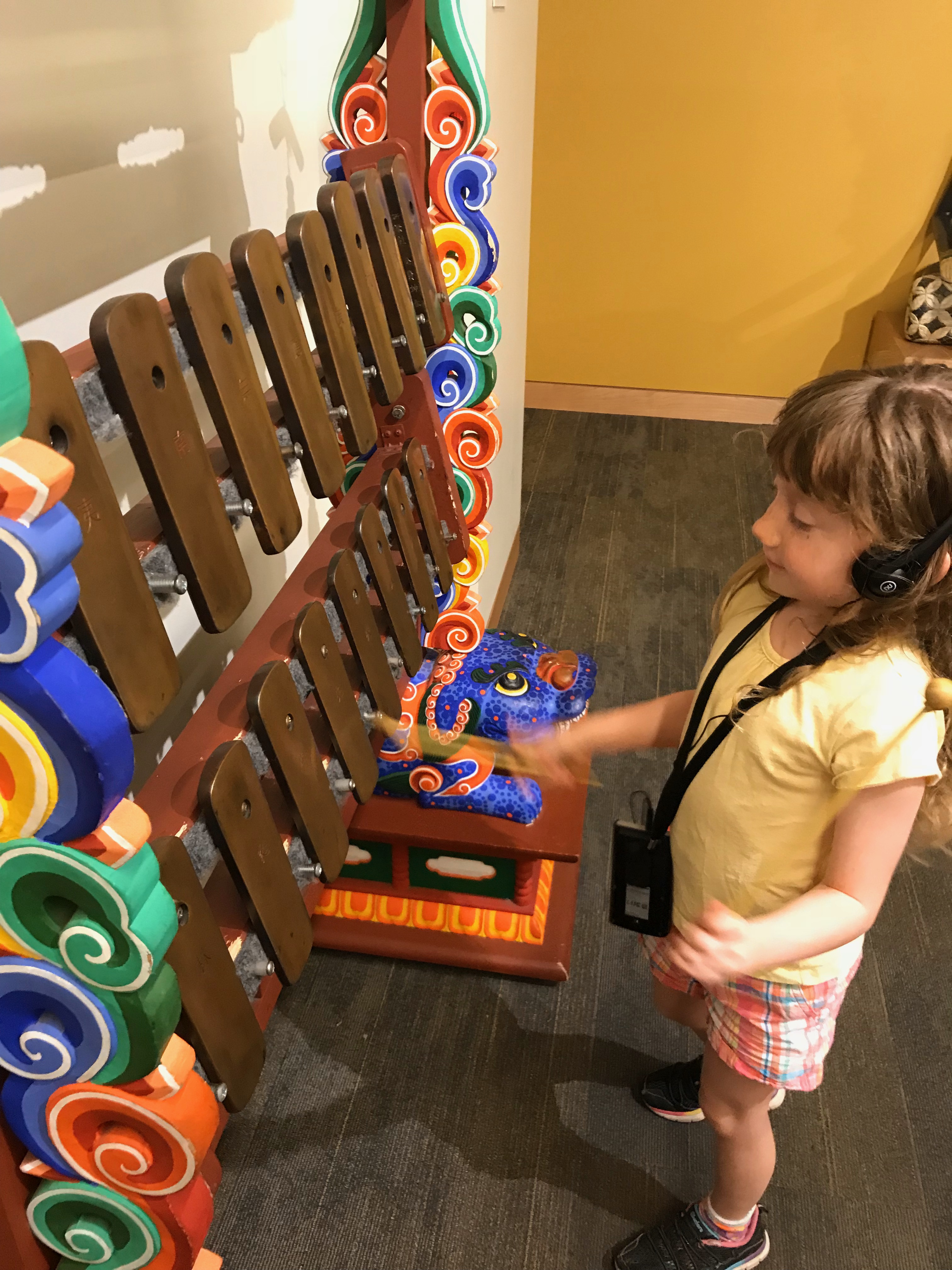
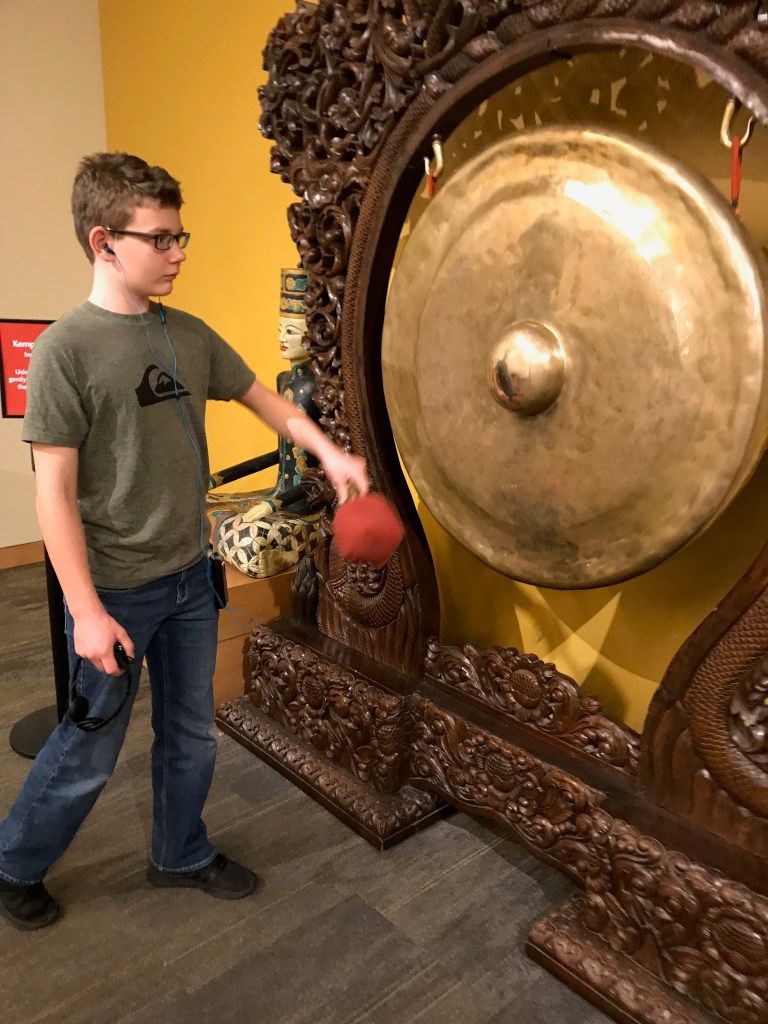
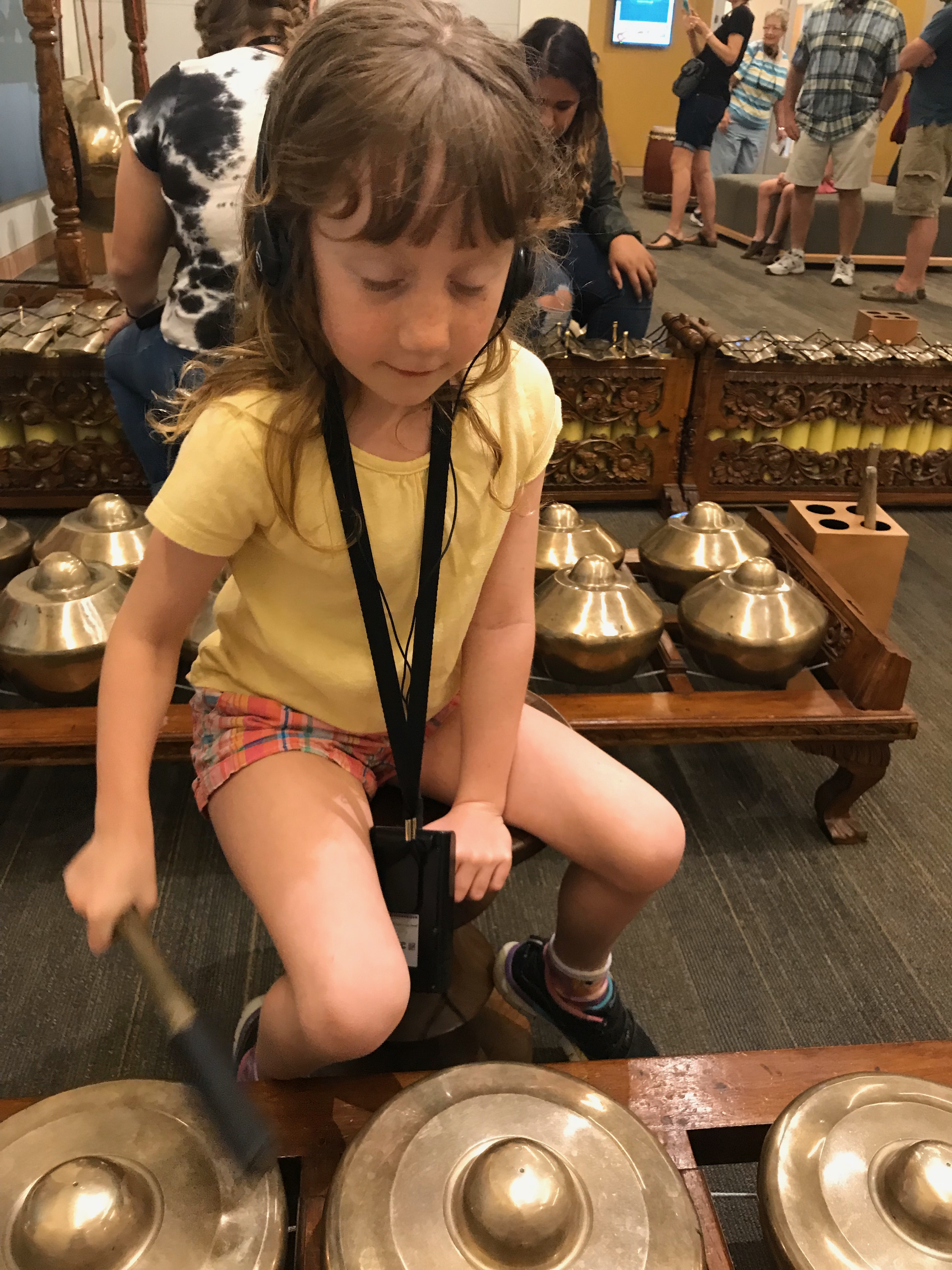
Our friends suggested we start our visit in the interactive room where there were so many spectacular noise makers.  I mindfully chose the word spectacular because there were many instruments, within this room and beyond, whose playing wouldn’t not create a spectacle.  WoodSprite intently went to work exploring these instruments.  

Firebolt was a little more reticent in her engagement, which surprised me as she is perhaps the most musically inclined of our flight.

And who wouldn’t be keen to set this gong to vibrating?

Outside the experiential room, the museum’s exhibits were clustered about five world regions: Africa and Middle East, Asia and Oceania, Europe, Latin America, and the United States/Canada.  Instruments from four of these five galleries resonated with me.  Having lived in Algeria when I was a kid, I was first drawn to learning more about the music that was specific to these Mediterranean countries.  
When asked to conjure an image of African culture, most Americans will never envision those that are unique to North Africa.  During our time in Algeria we made an incredible road trip across to Tunisia stopping at several long-forgotten towns of Roman ruins that litter the North African Coast.  I was nearly five years old and through the montage of my lived childhood experiences several from this trip stand out.  Most impactful was having my father the architect bend down to my level, point to the keystone at the top of a still intact arch, and give an impromptu age-appropriate physics lecture on why these architectural gems have lasted through the centuries.  Perhaps tied in significance with this memory was my own private moment of gleefully exploring on my own (my parents were probably 20’ away) and stumbling upon mosaic floors whose patterns were still discernable beneath the haphazard rubble.  I may or may not have absconded with a few of the tiles and carried them wherever I went for the rest of the summer.  Between those magical moments and seeing Raiders of the Lost Ark at age eight, I have long harbored a secret desire to become an archaeologist.  

But I digress, yet again…

Departing the African continent for Asia, I learned about the Shakuhachi musical art that evolved surprisingly out of the samurai tradition.  The elite samurai warriors were also expected to be accomplished artists and intellectuals.  When no longer called upon as warfighters, many became komusō monks, who were known as “priests of emptiness and nothingness.”  To demonstrate their separation from the material world, they would wear tengai (large baskets) over their heads while playing the shakuhachi.  This well-respected tradition is still practiced in Japan.  

Next stop was Indonesia’s musical treasures.  

I was intrigued by the modern set up for the Wayang Kulit, a traditional Indonesian shadow puppet show, but was disappointed to learn that we wouldn’t be seeing one today.  We had several Indonesian shadow puppets when I was growing up, a nod to my father’s birthplace.  I have never seen such a show performed in person and renewed my vow to learn more about my Indo-Dutch heritage. 

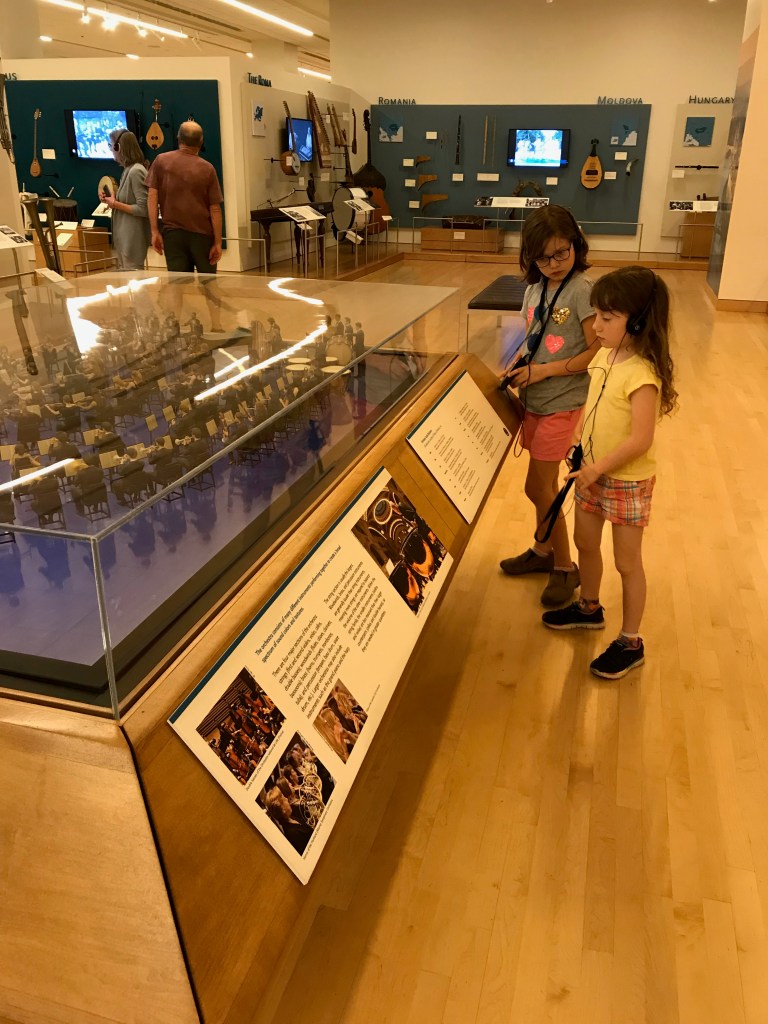
As our girls busied themselves learning more about the intricacies of a symphony, I meandered over to check out Scotland’s most iconic instrument, the bagpipe, which in days of yore were used to strike fear into the hearts of adversaries in battle.  Having been inculcated as a Highland Dancer in my youth, the sound of bagpipes wholeheartedly resonates with my Celtic warrior soul.  While I vaguely knew that other Celtic nations have used these instruments in their respective nation’s traditional music, I had no idea the pipes were so widely used across the globe.  

We tied up our visit to the MIM with a delicious lunch at the museum’s restaurant.  Beyond satisfying everyone’s rumbly in the tumbly, our time breaking bread with our friends was a delightful opportunity to reconnect. It was as though we’d seen each other only just last week instead of nearly a decade ago.  I’m delighted to report that the Phoenix sunshine appears to agree with them both and am already looking forward to our next visit, especially so I can get a photo with them, which I neglected to do this go around.  Next time… 

Oenophilia

For the interested, here’s a list of the wines we drank during our week in Phoenix, including the “wine dinner” wines.  There may have even been a few more, but these were the ones I managed to document.  I won’t pretend to have any special knowledge of these wines beyond the very basics, but I can avow that they were spectacular.  All of them.

Yow!

IMG_0839 (1)

Days of Wine and… Wine

OK that’s not ALL we did in Phoenix.  Far from it.  No, really.

We’ve learned how much we appreciate variety while on the road.  A little bit of primitive “dry” camping, some cushy private RV “resorts,” a generous smattering of wooded state parks with a ton of space, the very occasional beach cottage…  We haven’t been traveling long enough this go-around to really need what we got in Phoenix, but it was most certainly appreciated.  In fact, I would classify the week as “epic.”

My best friend from college with whom I commiserated on day 1 of Naval ROTC training back in 1986 is now an Emergency Room physician in Phoenix.  He lives on what I can only call a “compound” (in the very best sense of the word) in the middle of a fairly dense but entirely pleasant residential area with his lovely wife and four kids, whose ages match my kids’ perfectly.  We don’t communicate nearly enough and see each other even less, so a visit to Phoenix was a must, and when he suggested that we take over a corner of his 1.5 acre lot cousin Eddie style, I jumped at the opportunity.  This visit would entail a work trip out of PHX, so it would be a relatively long stay.

IMG_0838 (1)IMG_0835

Regarding the wine… I can’t really call him a wine enthusiast or aficionado, as neither of those words convey the level of commitment.  At the same time, “freak” goes too far.  Essentially he’s the best kind of wine geek – he’s been a well-educated fan since college and has aggressively collected and studied wine as a hobby since then, with his cellar size more or less tracking with his means.  For years it’s been so large that he needs to store it off-site.  But he’s not ostentatious or pretentious about it – he likes to drink it and enjoy it with friends, not display it and save it.  And yet he’s not really a “drinker,” so a very basic calculus problem will demonstrate the degree to which his cellar growth has vastly outpaced his rate of consumption.  At some point he played that math forward and realized he needed to slow down his rate of purchase and find more occasions to pull out the really good stuff.

This, lucky for us, was one of those occasions.

We drank well.  Oh man did we drink well.  But even more fortuitous was my being in town during one of his annual “wine dinners” with a few like-minded friends of his.  It’s a ridiculously exclusive thing where they pull out all the stops for a night, have a catered dinner, and taste 6-7 wines centered on a theme.  This year’s theme was Andy Beckstoffer grapes, which I knew nothing about previously but rapidly got up to speed on.  It was by no means a given that I would be able to attend this dinner, but he was able to grease the skids for my attendance.  I’m convinced this was a once in a lifetime kind of thing for me.

But I’ll stop there with the wine geekery and put the details in another post for the curious.

The overarching theme here is that the visit was a smashing success and fed the soul.  Our kids got along famously and will likely continue to keep in touch.  The weather was perfect.  The adults, with several nights lounging by the pool while the kids played, had enough time to catch up and reconnect in earnest.  So often time constraints rush that sort of get-together; not so this time.  Even with school, work, and the typical life stuff we all manage, we were able to cook together, eat together, watch our kids play together, and do just the right amount of reminiscing.

IMG_0868IMG_0862IMG_0877IMG_0853

Every morning I would get up and wander over to their enormous grapefruit tree to pick a few for breakfast – incidentally that’s the best way to make your kids grapefruit fans.

IMG_0852

Keeper and I pulled out our drones and took advantage of their enormous yard to practice flying them around and scaring their dog.  OK, that part wasn’t on purpose, but was an amusing discovery, after which we steered the drone clear of him.  He really didn’t like that thing.

One day gave us the opportunity to head north (and up) to Sedona.  On another we met up with some old Whidbey Island friends at the Musical Instrument Museum.

IMG_0842

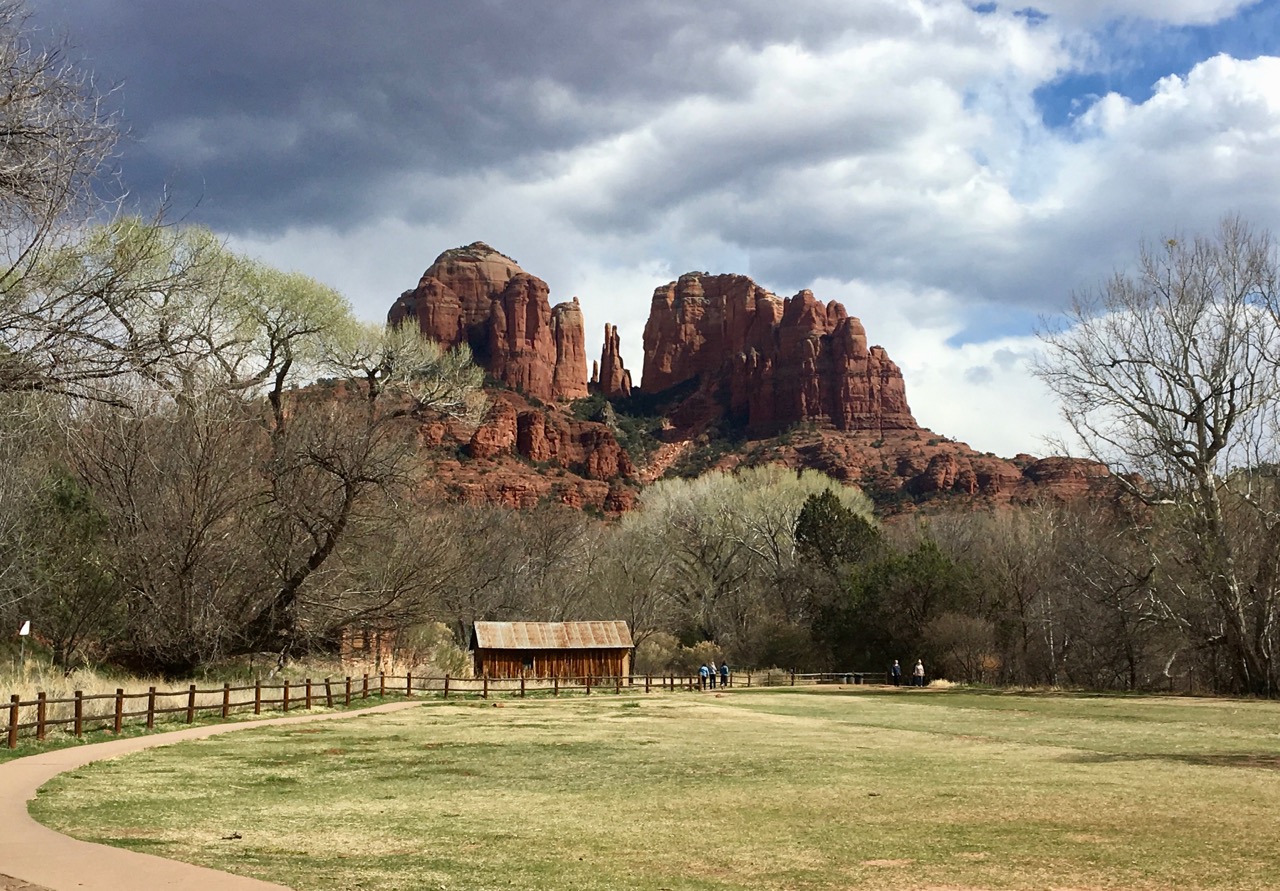
Sedona was stunning, but felt a little commercial to me.  Back in Washington there are a few mountain towns that took an emerging theme and decided to go whole hog with it as sort of a marketing ploy.  Successful marketing by the way — they’re fun towns and get a ton of visitors.  But still, there’s a veneer of inauthenticity to it that you have to either ignore or decide it’s part of the fun and roll with.  Sedona, to me at least, felt like “hey, come visit the New Age theme town!”  I don’t know how deliberate that was on the town’s part and it may be an unfair characterization, but that was my take.  The crowds and horrible traffic (on a Monday!) didn’t help.  And it certainly doesn’t need the marketing – the scenery is spectacular and stands on its own.  I’m told there is also a very real energetic feel to the place that undergirds its reputation.  Both Tacco and one of my friends’ kids mentioned sensing it.  I didn’t, but I did appreciate the red rocks and jaw-dropping vistas.

IMG_0818

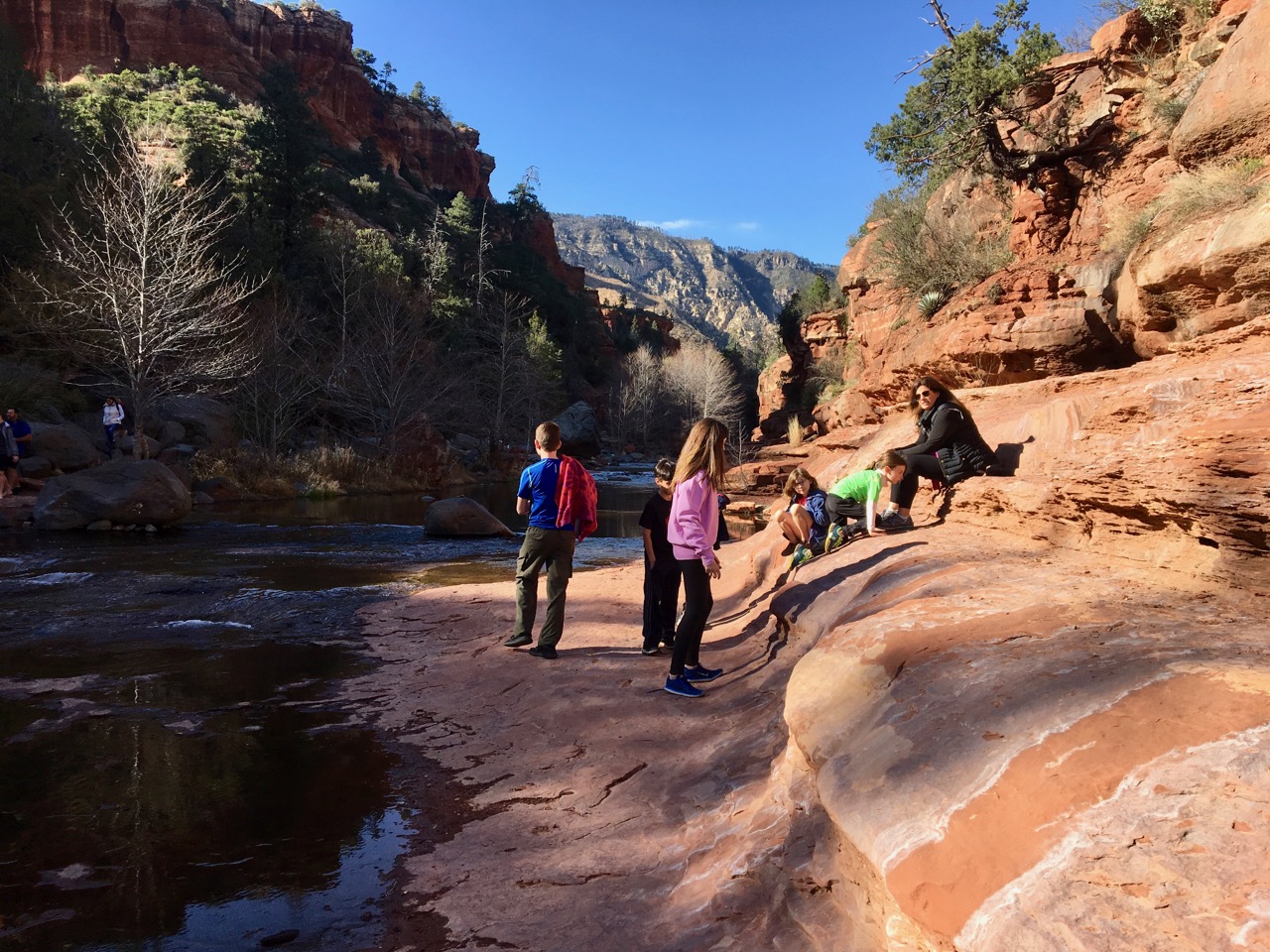
We took a short hike along a stream that runs through town and stacked rocks within an “energy vortex.”  Vortex?  Maybe not — it might have been an energy perturbation or a confluence.  The ranger at the park entrance even mentioned it when we paid our entrance fee.  But I forget how he billed it.  It looked cool though.

IMG_0806

IMG_0816

It would’ve been nice to take a dip or at least wade there, but the weather was actually quite chilly despite the sun.  It sits at about 4500’, so even in the summer it can be crisp.

IMG_0815

IMG_0817


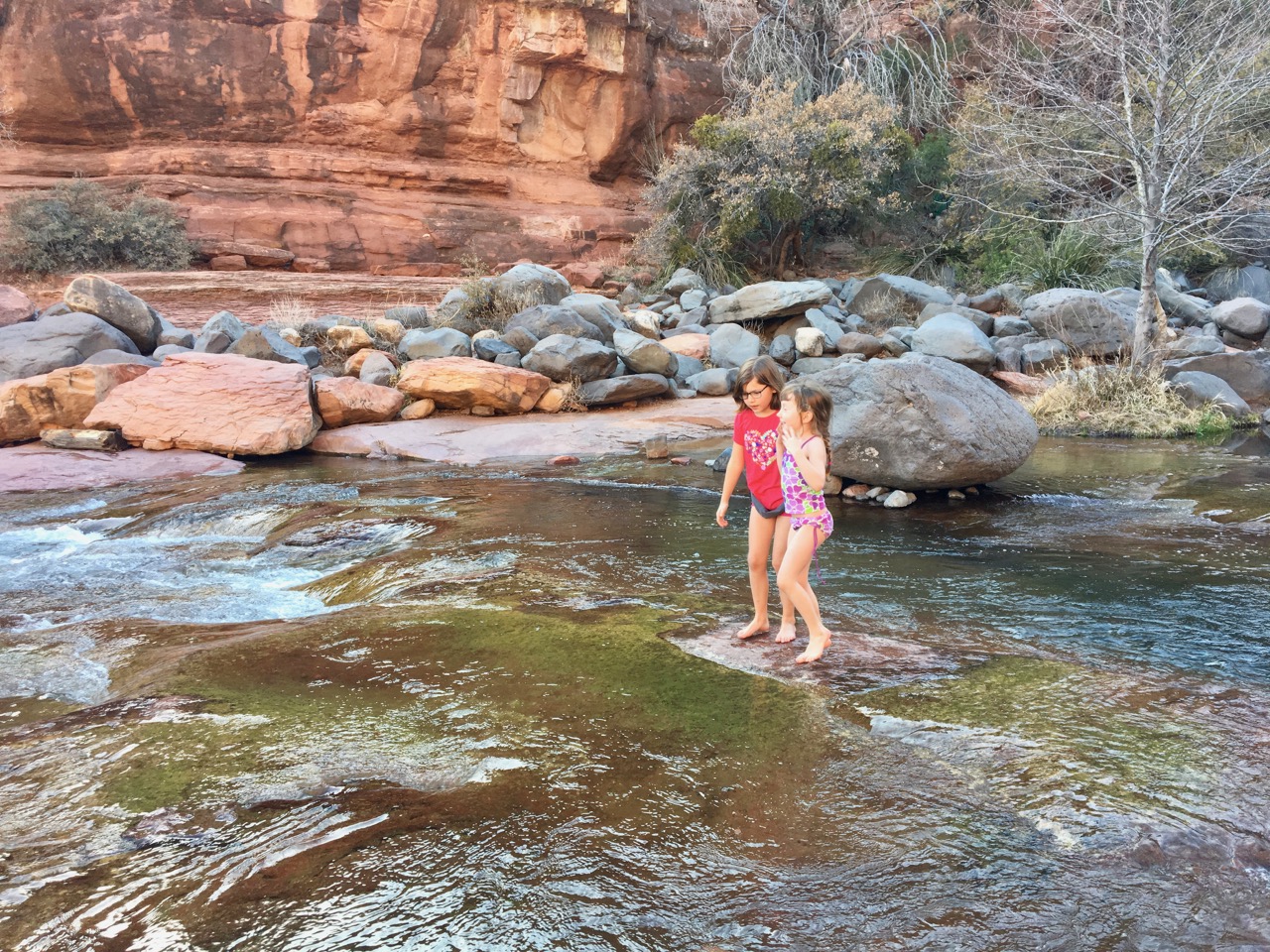
We drove (crawled?) through town thereafter, on the way to Slide Rock State Park.  It’s billed as a refreshing antidote to the summer heat – which, as a mountain stream cascading over some slippery red rocks, it would be.  It’s less of an antidote to a bracing March afternoon, particularly when you arrive there after the sun dips behind the canyon walls.  The kiddos were nothing if not game, though, and Keeper made waves as it were by being the only one there to go full immersion in the chilly water.  That’s my Pacific Northwest boy!

IMG_0822IMG_0829

IMG_0828

He tried to do some sliding in order to get others to join him, but the rocks turned out to be not especially slippery.  I guess Sit On Your Butt And Push Yourself Over The Rock State Park is a less catchy name.

IMG_0823

On the way back down the hill we split off from the others and enjoyed an excellent dinner with Tacco’s aunt and uncle, whom she hadn’t seen in years and was looking forward to catching up with.  Loving these Target Of Opportunity visits — huge benefit to this lifestyle.

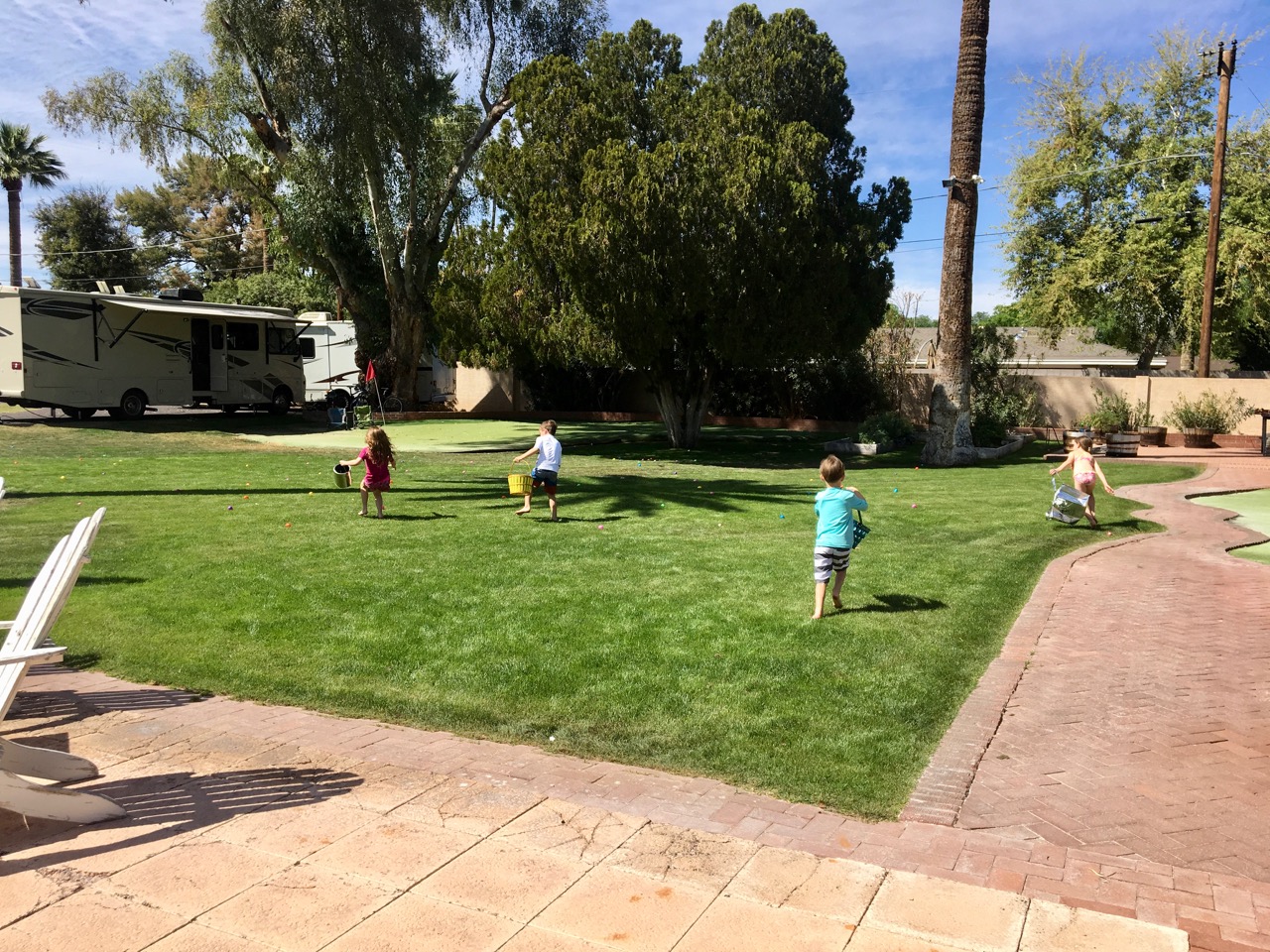
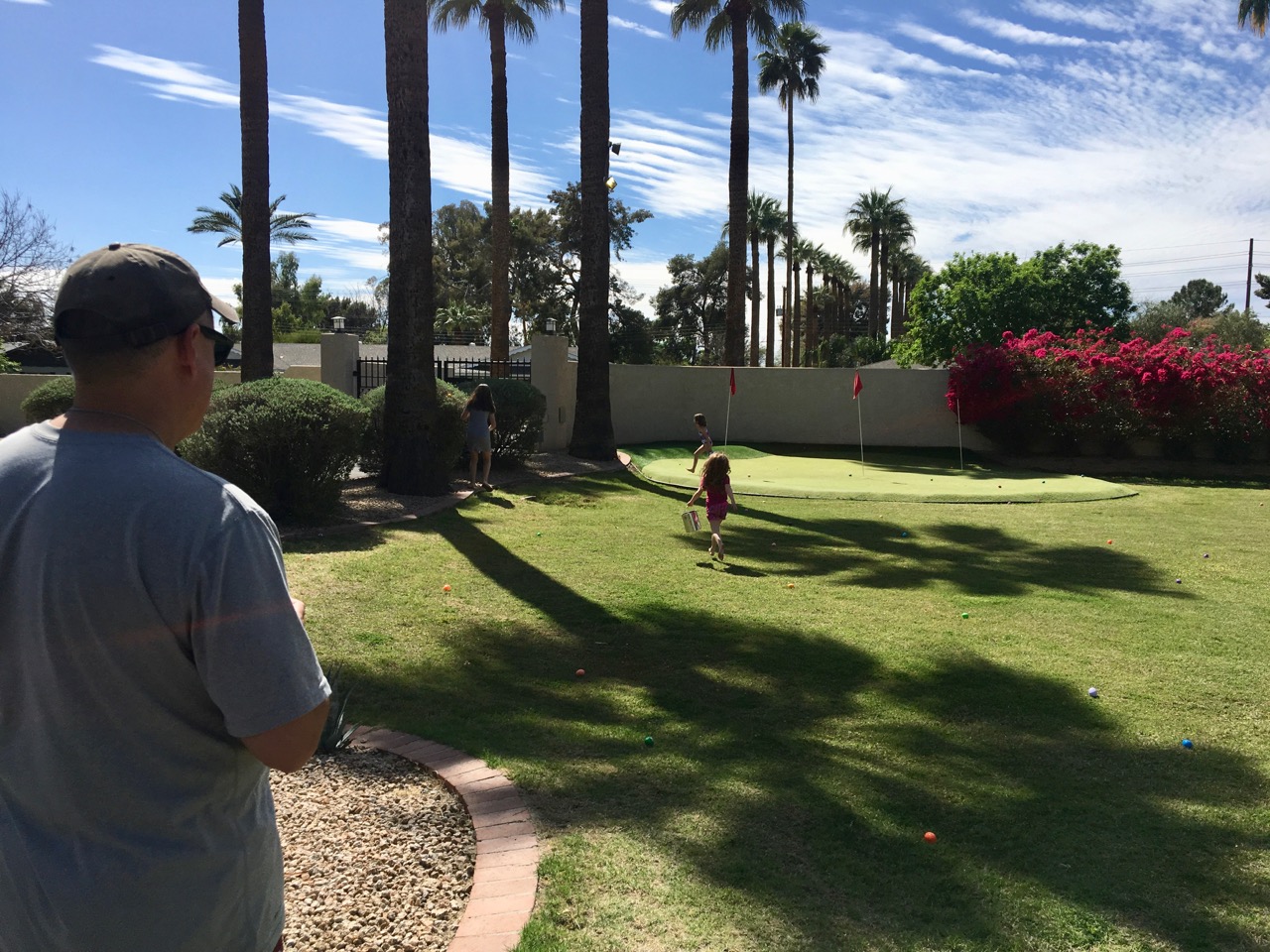
Easter Sunday was another highlight.  A sizable chunk of their extended family calls Phoenix home, and Easter is a traditional get-together time for them, so we were able to take part in a perfectly chaotic Easter Egg hunt for the kids as well as a sunny, lounge-y, nibble all afternoon sort of day.

IMG_0856

IMG_0858IMG_0860We had planned to depart on Monday after Easter, but we all agreed that one more day just hanging out with nothing at all to do (they weren’t working and their kids started Spring Break) would be a far better use of our time than trekking east to City of Rocks State Park in New Mexico.  So we stayed another day and chopped City of Rocks off the list, rationalizing that if we did a dawn patrol departure on Tuesday we could easily make it to Carlsbad Caverns.  So glad we made that call.  More swimming, more running around the yard (the kids, mostly), some insanely good pizza, and yes, some more wine.  Perfect.

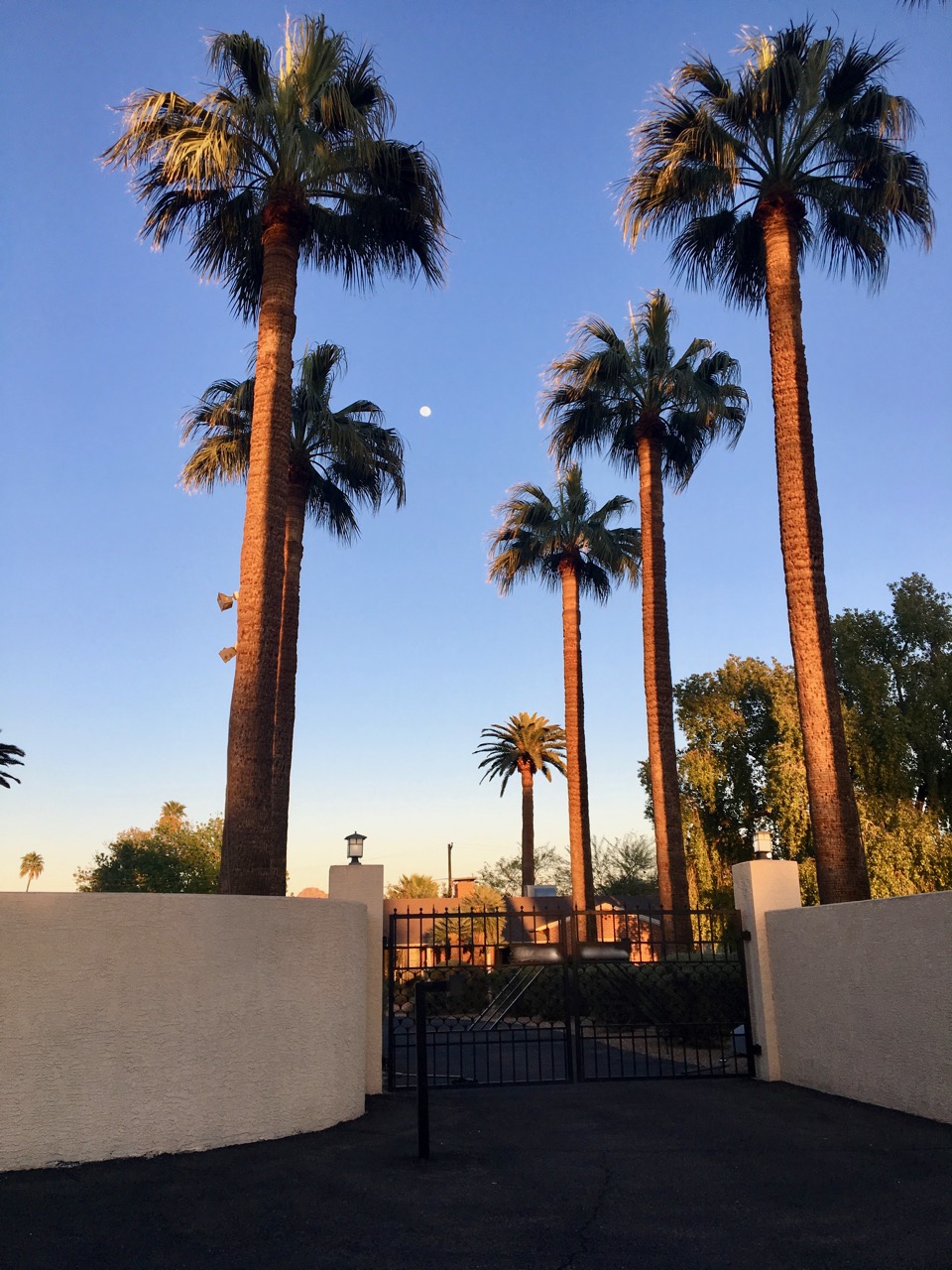
We said our goodbyes in the evening and pre-positioned Davista+Toad for our planned 4:30AM departure.  My intent was to get up, make a cup of coffee and shower to wake up, open their gate, and roll with everyone still asleep.  Prior to the goodbyes, though, I decided it would be a good idea to fly the drone one more time.  Why on Earth would you do that, you ask?  Exactly.  It seemed really smart at the time though, and yes, there was wine involved.  I flew it straight up to clear all the palm trees and also to show off a little bit, and it almost immediately caught some upper level winds and took off to the north.  Not being GPS stabilized like the more expensive drones, it’s both very susceptible to such things and tricky to orient so as to get it flying back toward you.  More so once it starts tearing away and the tiny lights are all you can see of it.  Had I been able to orient it perfectly back toward us and get it back down out of the higher winds I might have had the chance to show them what an amazing pilot I am.  “I’m going to be impressed if you’re able to recover that” was the last thing I heard (along with the beeping of my controller, informing me that its commands were no longer reaching the drone) before I watched it disappear behind some distant trees.  I felt like I was in high school again as he and I tooled around the neighborhood in the dark, scanning the trees and walking quietly up to people’s backyard walls and peering over them, hoping to catch sight of my wayward drone and wondering what I’d say if the lights in the house suddenly came on and the resident asked what an almost-50-year-old man with a baseball cap on was doing climbing their wall.  It was fun.  Didn’t find the drone though.

[P.S. She found it the day after we left and shipped it to one of our future stops.  Awesome.  Evidently it went far further than he and I had been looking!]

Overall we hated to leave, but appreciated having such an opportunity.  The kids made new friends and got some solid play-with-kids-our-age time and we got to have the kind of week with friends that you really only get a few times per lifetime I think.  It strikes me in retrospect that that’s a large part of why we wanted to do this trip in the first place.

IMG_0867